Colombia
COLOMBIA BORDERLAND SECURITY PROPOSAL: Colombian Security Challenges in Arauca & Catatumbo

Executive Summary
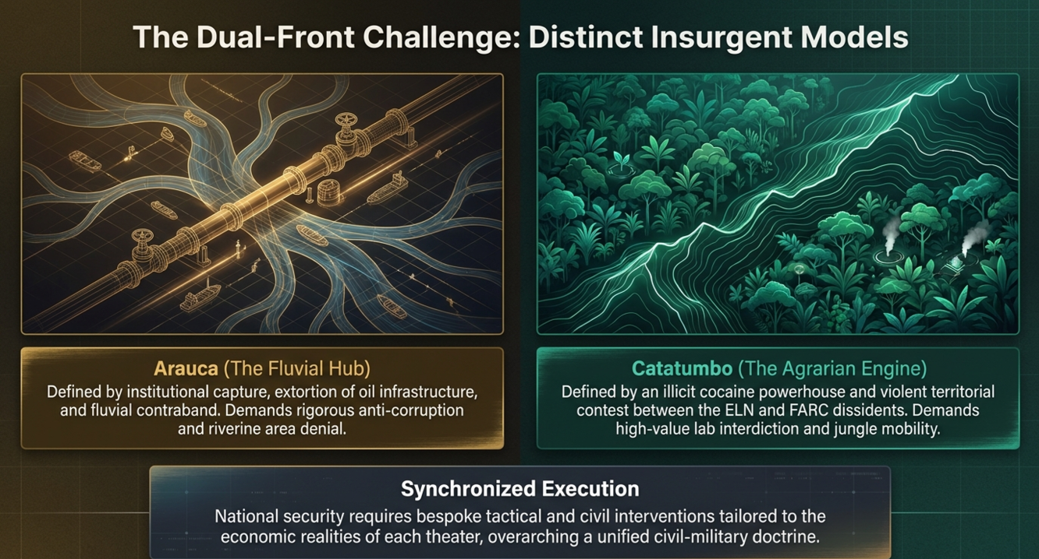
Colombia's Venezuelan border represents a complex geographical space characterized by overlapping insurgent networks, porous administrative boundaries, and highly sophisticated smuggling economies. This briefing analyzes Colombian security challenges in the two most geo-stragetically critical entry corridors in its northeastern region and proposes a coordinated approach to the security threat to the Colombian state: Arauca and the Catatumbo subregion of Norte de Santander. While both corridors are heavily exploited by leftist rival groups, the National Liberation Army (ELN) and the Revolutionary Armed Forces of Colombia (FARC) dissidents, as operational sanctuaries, their underlying economic mechanisms represent two distinct geostrategic models. Arauca functions as a low coca fluvial transit hub dominated by fuel, cattle, and public contract extortion rooted in deep insurgent co-government (cogobierno). In contrast, Catatumbo operates as an illicit cocaine agricultural and manufacturing center defined by land-based smuggling trails, riverine routes to international distribution channels, and intense conflict over high-density coca cultivation between the ELN and FARC. Managing these border regions remains one of the Colombia's most acute security challenges.
Arauca: The Fluvial Contraband Axis & Insurgent Co-Government
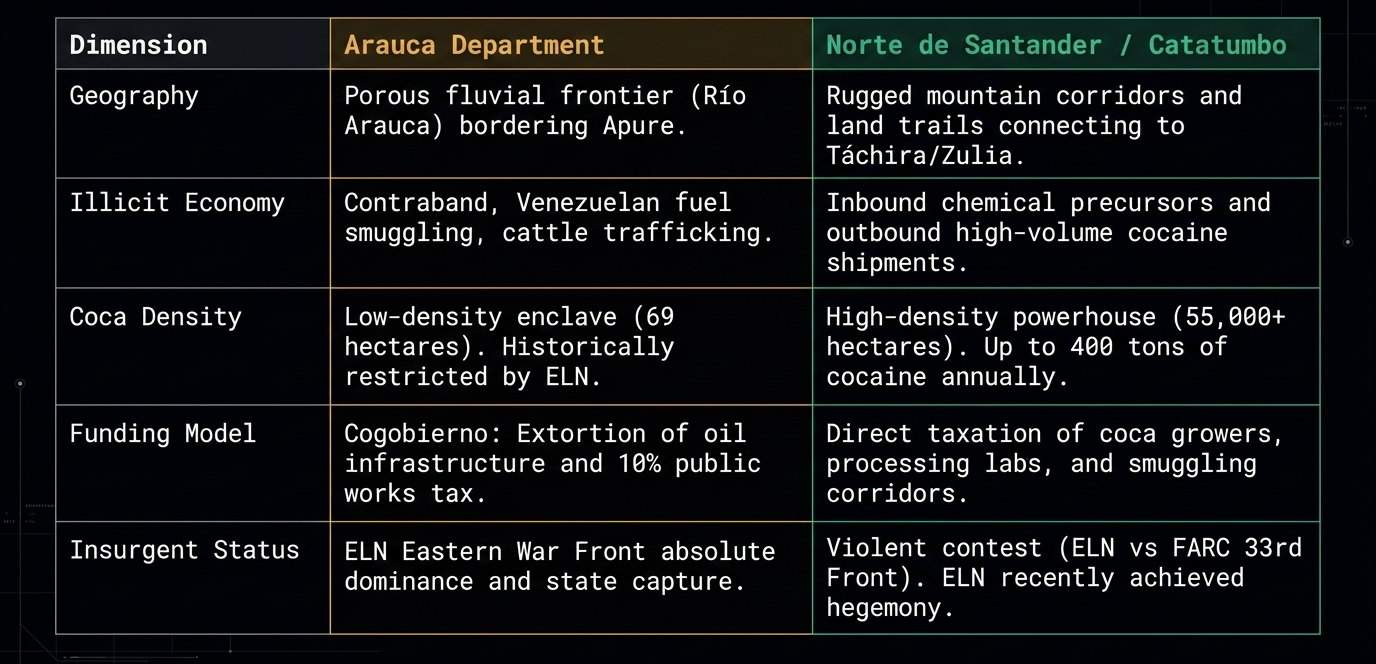
The geostrategic landscape of the Arauca department is physically defined by the Arauca River, which serves as a porous international boundary separating Colombia from the Venezuelan state of Apure. For border communities, local merchants, and armed actors alike, this international line is essentially imaginary. The river functions as a continuous riverine highway used by the ELN’s Eastern War Front to transport contraband, Venezuelan fuel, and smuggled cattle with complete tactical mobility. This has, in the past, allowed ELN rebel troops who dominate this department to easily retreat into pro-regime (Chavez/Maduro) sanctuaries in Apure when pursued by Colombian government forces.
The Arauca Coca Prohibition:
Unlike other insurgent enclaves, the ELN historically oversaw a policy in Arauca that restricted and prohibited large-scale production of coca crops. This was done in coordination with local peasant unions to prevent rival armed factions (such as FARC dissidents) from encroaching on their territory. According to official registries, Arauca only hosts 69 hectares of coca, compared to Norte de Santander's 55,000 hectares.
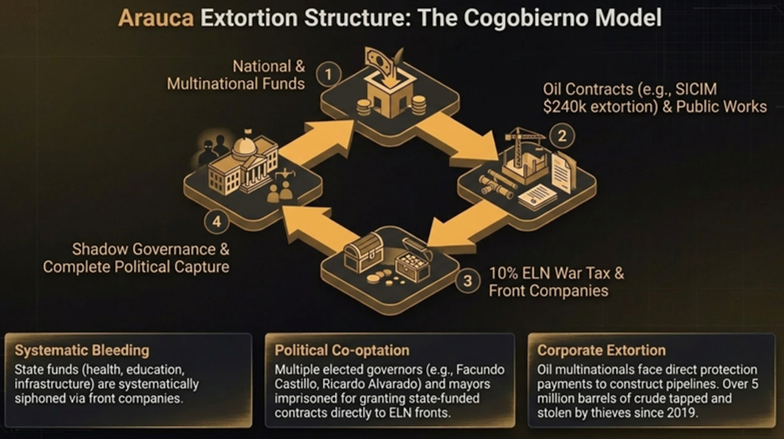
In the absence of a strong, permanent state presence in Arauca, the ELN’s Eastern War Front has established a system of shadow local governance, or cogobierno. Rather than depending on coca rents, the ELN funds its local operations by taxing regional petroleum infrastructure - extorting oil multinationals like SICIM for up to $240,000 to construct pipelines - and systematically taxing 10% of all public works and municipal development contracts. This co-optation of the formal political sphere is so complete that multiple elected governors and mayors in Arauca have been imprisoned for collusion with the ELN, illustrating the extreme capture of regional public funds.
Norte de Santander: The Catatumbo Cocaine Powerhouse & Bypass Corridors
Norte de Santander, centered on the rugged Catatumbo subregion bordering Venezuela's Zulia and Táchira states, represents a fundamentally different economic engine. In contrast to Arauca, Catatumbo is a high-density illicit cocaine growing and production region. The region hosts over 55,000 hectares of coca crops, capable of producing up to 400 tons of pure cocaine hydrochloride annually. This illicit trade generates an estimated $600 million locally and up to $10 billion once exported into the global marketplace. Consequently, the smuggling infrastructure of Catatumbo is heavily oriented toward the inbound transit of chemical drug precursors and the outbound maritime export of finished cocaine, utilizing river routes like the Catatumbo and Zulia rivers that lead directly into Lake Maracaibo.
The January 2025 Transnational Bypass:
To completely avoid Colombian military checkpoints, up to 200 ELN Eastern War Front fighters launched an attack into Catatumbo against FARC from Venezuela. Instead of crossing Colombian territory, they marched through Venezuelan border municipalities starting at the crossing of El Nula (Apure), traveling to San Cristóbal (Táchira), continuing through La Fría, and connecting via Zulia directly into Tibú. This enabled a devastating surprise offensive that displaced their rival, the FARC's 33rd Front, and consolidated the ELN's borderland hegemony.
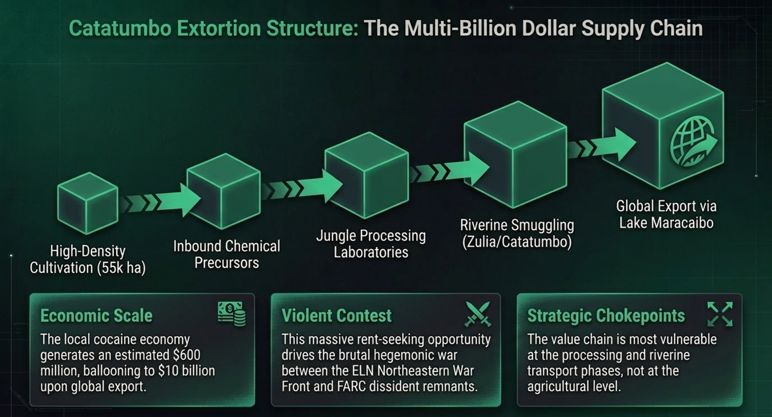
Due to these lucrative drug rents, Catatumbo has historically been subject to intense violent conflict with funding armed dissident groups at its center. The ELN and FARC dissidents (such as the 33rd Front) have fiercely competed for territorial control. The ELN's not too distant past strategic alignment with elements of the Venezuelan military has given them a critical asymmetric advantage: during the ELN's early 2025 campaign, the Venezuelan Armed Forces (FANB) launched 'Operation Catatumbo Lightning' which selectively targeted the FARC's 33rd Front structures in Zulia while leaving the ELN completely untouched. This symbiotic relationship with Venezuelan state elements has allowed the ELN to establish a continuous, hegemonized border corridor tracing nearly half of the binational frontier.
Human Terrain Impact: The Colombian Security Challenges to Local Dispute Resolution
The impacts of these intense border security dynamics are deeply rooted in the historical conflicts of the 2000s. Under former President Álvaro Uribe's Democratic Security Policy (2002–2010), the national government sought to extend formal justice structures (such as Equity Conciliation and Community Justice Centers) into remote zones. However, due to the weakness or absence of formal state institutions, rural communities in Arauca and Catatumbo depend heavily on traditional dispute resolution systems—including localized justice boards, communal assemblies, and elder mediation—to maintain social cohesion and resist insurgent-imposed combatant justice.
Critical strategic failures occurred when Colombian military forces pressured these traditional, non-state justice boards to coordinate directly on security operations and act as extensions of state intelligence. Because the authority of these community mediators depended entirely on their perceived neutrality, cooperating under pressure significantly degraded their local standing. Leftist guerrilla groups across the country (including major players such as the ELN and FARC) viewed any cooperation with state authorities as active collaboration and initiated brutal waves of targeted assassinations and forced displacement against community elders. This structural pressure ultimately resulted in the total collapse of informal local justice mechanisms across both departments, leaving rural populations entirely vulnerable to the harsh, unilateral control of armed actors. In contrast, high quality, informal/formal local institutions allowed local leaders to maintain a high degree of autonomy in local dispute resolution prior to intervention by the central government of Colombia.
Strategic Takeaways for Regional Defense Policy
In Arauca:
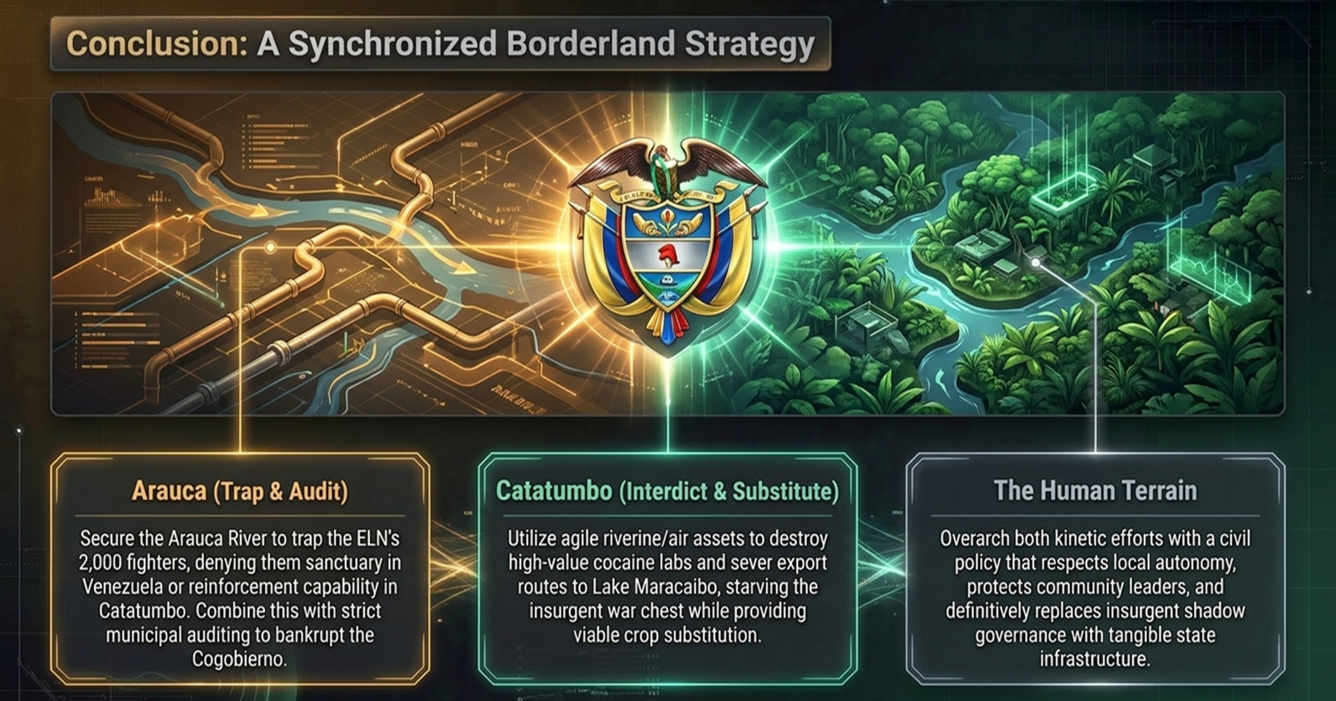
Defense policy must prioritize neutralizing public contract diversion and protecting energy infrastructure as this will likely be targeted by ELN in the event of military operations that broadly threaten their hold on the department. Because the ELN's local governance relies on state capture, reinforcing transparency and oversight in municipal bidding processes is as critical to defeating the insurgent hegemony as direct military force. To accomplish these objectives government forces will need to cut off ELN from its traditional sources of funding in the department as well as restrict its ability to freely move across the border to sanctuary zones in Venezuela.
-
The Arauca River is key terrain and critical for any military endeavor to succeed in the border region. A robust national military riverine force must project power along this waterway and deny its use to armed adversaries. This effort demands increased presence-patrols along known ELN cross river smuggling points around Arauca (capital) and Arauquita, with significant tributary patrols in between. In support of these patrols, riverine forces must increase troop and patrol boat numbers from bases at these key cities (Arauca, Arauquita). Arauca riverine patrols must be sufficient to drastically reduce oil, cattle, arms, and other contraband smuggling as well as to protect legitimate commercial activities from ELN tolls.
-
The area denial aspect of this must also act to cordon and restrict ELN ability to freely travel into Venezuela. Importantly ELN units in Arauca should be denied the ability to reinforce its activities in Norte de Santander’s Catatumbo Region as it did in the 2025 offensive conducted against FARC adversaries there. In support of this effort, Colombian Army units should also establish presence in Saravena to deny ELN travel along HWY 66 northward into Norte Santander from the Colombian side of the border.
-
Having secured the Arauca River, Colombian efforts should project power into and from the city of Tame as it sits at a convergence of several highways that access greater parts of the Piedmont area where ELN activity is most prolific. This effort gains strategic security for a significant population center deep in ELN territory and enables surgical strikes on high value targets within ELN leadership and facilities.
-
At each step, Influence Operations should be shaping the human terrain environment. Previous campaigns against armed non-state actors, such as Operation Liberty (Plan Patriota 2003), achieved impressive wins against ELN and most notably FARC dissidents. However, failure to create and validate intelligence sources combined with military co-opting of local dispute resolution institutions gave these dissident groups unearned public relations sympathies while weakening local populace cohesion. Past examples of where to look for successful Influence Operations include Operation Jaque. Operational successes that demonstrate demobilization of dissident fighters, manipulation of dissident communications networks, and civilian non-interference abound and serve as a trove of lessons learned for future operations. GEOS (Colombian Tactical PSYOP teams) are force multipliers that can enhance power projection reach for military commanders at multiple phases of operation, sustaining momentum in support of or beyond kinetic requirements, and should not be overlooked when considering implementing these steps.
In Catatumbo:
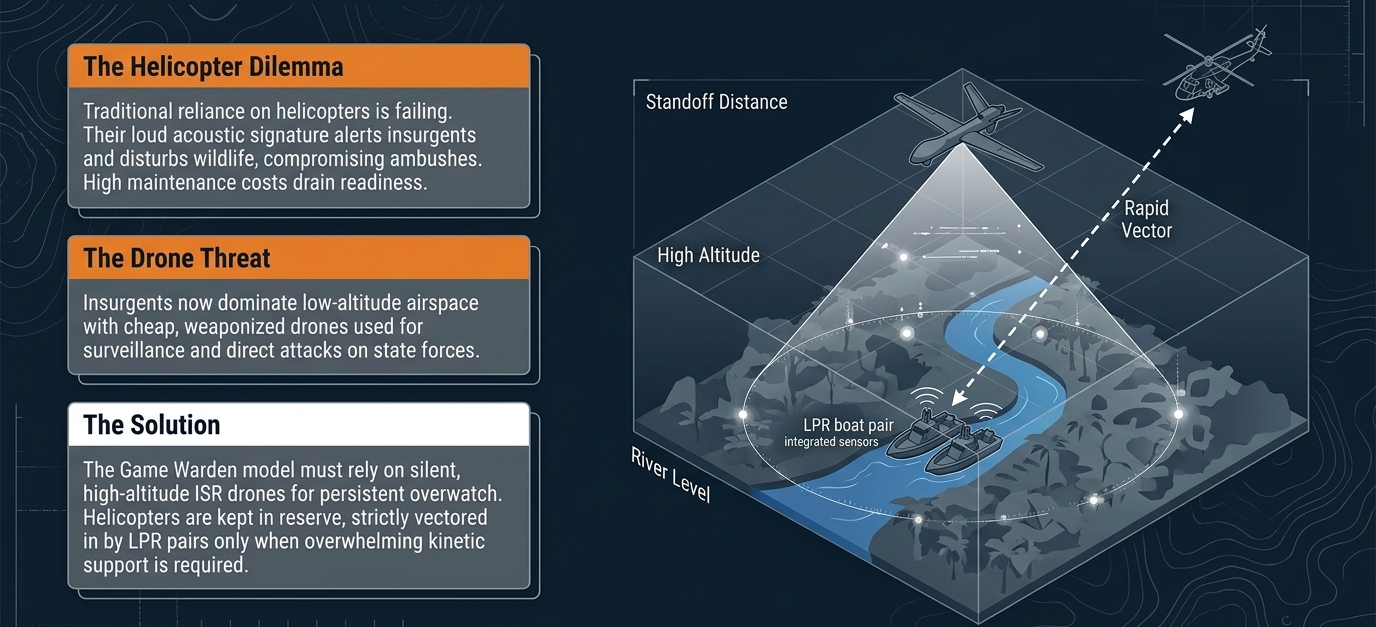
Focus must remain heavily on interdiction of riverine smuggling pathways while providing robust, state-protected voluntary crop substitution programs to drastically reduce cocaine production. To this end past efforts have heavily invested in crop destruction but at the cost of rural citizen support and at great financial expense, an endeavor that has rapidly diminishing returns on investment. Early and middle phase military operations commanders should consider that engaging in cocaine crop destruction is too costly to their tactical momentum while better targets exist. It is, however, vital to choke off insurgent funding by dismantling the lucrative cocaine laboratories and securing transport corridors leading to Venezuelan exits. This is most effectively gained by aggressive action to destroy ELN/FARC in detail by speedily reaching into remote insurgent strongholds, starting in high-density populations but expanding into rural towns at key terrain points whenever possible and while state security forces guard the local populace.
-
Catatumbo River is key terrain regarding the cross-border transport of finished cocaine from Catatumbo sub-region to Venezuela's Lake Maracaibo where it is distributed to a global market. For a riverine force in this area to be most effective, it requires shallow draft boats for patrolling tributaries and delivering small units deep into armed group territory where they can conduct disruption operations and shut down rural smuggling routes in order to strangle funding through the export of cocaine.
-
These small unit interdiction teams, in addition to units tasked with the destruction of armed group facilities, must be able to operate in dense remote jungle while coordinating their efforts with close air support. Joint operation tactics such as these proved extremely effective in the early years of Operation Liberty under the Uribe-Velez government of 2002-2010.
-
Influence operations in this sub region would be well placed to exploit the brutal contest between the ELN and what remains of FARC. Opportunity potential exists to open HUMINT/SIGINT channels using FARC sources (by design, infiltration, coercion, or deception) to identify ELN controlled cocaine processing areas, bases of operations where ELN concentrate fighters, or likely routes used. In addition to utilizing GEOS capabilities to support kinetic operations efforts, by for example inducing mass desertions, messaging to the local populace must be implemented. Influence operators are uniquely positioned to understand how to obtain ground level civilian support and how to direct military interactions with civilian key leaders in such a way to support tactical advantage. This would allow the Colombian Government to foster a functional civil society and implement foundational state integration with customized local dynamics since the Colombian military still enjoys popular support with civilians.
Civil Influence Operations:
In both Arauca and Catatumbo, any future effort to restore local stability must actively protect the neutrality and independence of traditional, non-state community mediators. The Colombian Government must take particular care to avoid reverting to the counterproductive doctrines of past administrations such as co-opting and resolving local disputes as an extension of state military intelligence. This is necessarily a prime psychological objective: that is, to increase the perceived legitimacy of the state. Cooperation from the local populace (which can be voluntary or coerced) is the primary means by which armed groups exercise control of territory. A significant reduction of tangible forms of local community support to these armed groups, commonly provided as goods, services, and shelter, must be pursued as a supporting psychological objective
-
State legitimacy messaging must flood national television, social media, regional radio with messages of state dominance and military presence, as was seen to be effective during Operation Liberty. The state push for civilian collaboration created huge backlash in the form of widespread public criticism and public relations opportunities for ELN and FARC. With a slight change in tactics on the ground, it is evident that these miss-steps are avoidable. Such harsh tactics may have provided immediate intelligence but fractured social fabric of rural communities by sowing distrust and paranoia between neighbors. Military commanders and their units who remain tactically agile, and social leaders who attend to civilian matters that might otherwise be costly to state institutions in resources or reputation will see the most beneficial measurable effects.
-
This effort should contain a messaging series and budget to target young men from the region for recruitment into units like the Carabineros, rural security/militarized police, which will serve to provide badly needed income and divert these men from working with ELN or FARC.
-
Isolate ELN and FARC from civil support networks by coordinating military with state social entities to build infrastructure, deliver healthcare, construct schools, and establish roads in previously neglected zones.

Strategic Assessment
Any military strategy that seeks to secure either Norte de Santander or Arauca and pry it from ELN/FARC control demands that both departments be synchronized into a coordinated operations plan. Early phase operations require establishing control of key terrain. For example, ELN has a history of crossing the Arauca River into Venezuela to attack its FARC rivals in Catatumbo. This river must be secured and used by the Colombian army to screen for subsequent maneuvering in Catatumbo by denying the ELN opportunity to send reinforcements from Arauca to engage troops in Norte de Santander or its subregion. A precedent (2021 Clashes in Apure, Venezuela) for troop surges has shown that when needed the Colombian military can bring the riverine troop numbers up to an estimated 2,000 soldiers within relatively short timeframes. However, this surge was still considered undermanned and used static checkpoints that failed to patrol areas farther from population centers. Simultaneously, riverine units in and around the Catatumbo River must deny river transit to smugglers carrying processed cocaine down river where it will be shipped to international markets from Lake Maracaibo. This will cut off a massive source of funding for the ELN and what remains of FARC forces in the region.
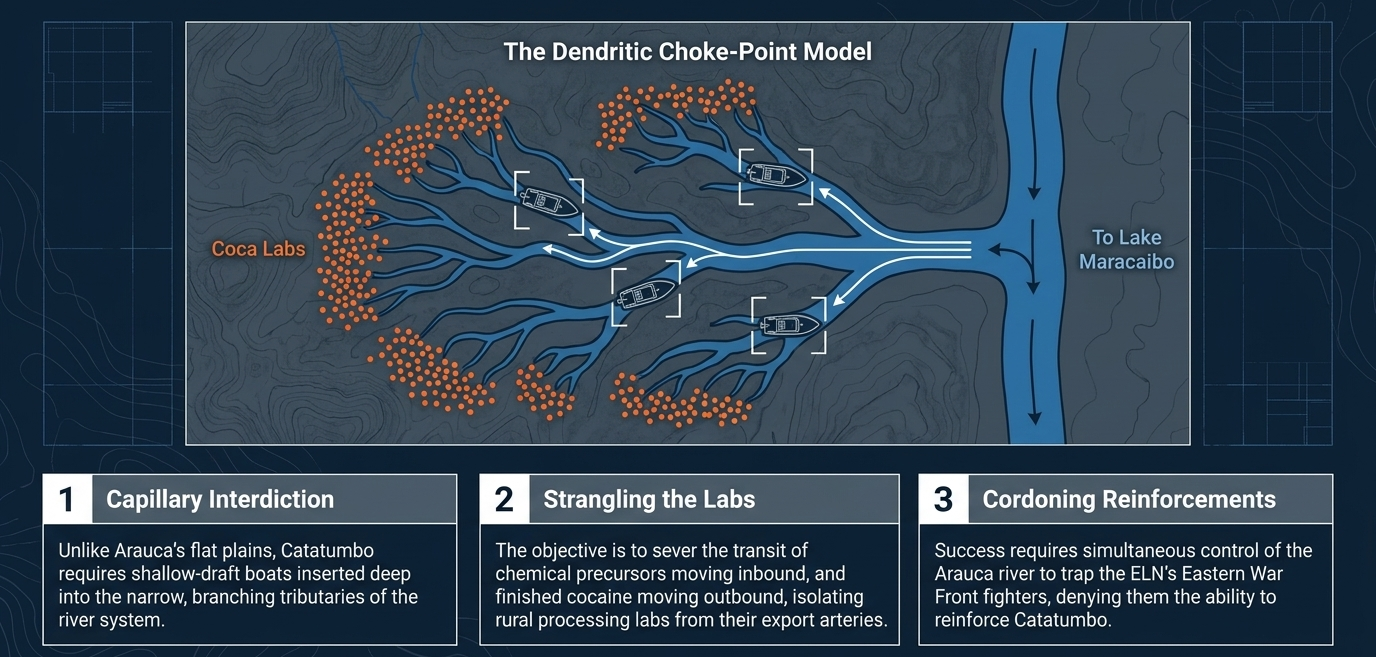
An aggressive, coordinated action strategy is bound to provoke a violent response from either group, making it critical to trap ELN Eastern War Front’s roughly 2,000 fighters in Arauca. If cordoned sufficiently, ELN forces in Catatumbo (numbering around 1,500 fighters) will be left without external support, which permits ideal conditions for retributive actions against them from the approximately 500 remaining fighters of FARC’s 33rd Front.
Securing the Arauca and Catatumbo River systems will require small, agile units, that have close air support and use shallow draft boats. Boats that can deliver soldiers along smaller tributaries into remote areas where they can operate over longer periods of time. To find characteristics suitable for this environment there are a few examples, such as the ReconCraft RSDV-21cc custom built for U.S. Customs and Border Protection (CBP). These riverine interdictors excel in shallow, debris heavy, obstructed water ways due to a flat-bottomed hull and waterjet intake making it operational in just 10 inches of water depth and, in this terrain, can equip commanders with patrol tactics that brought so much success during Operation Liberty.
The doctrinal lessons learned during Operation Liberty would be applied to the riverine force itself. Current doctrine dictates that river patrols are centered on larger, slower boats (PAFs) acting as tenders, leading patrols and orbited by smaller boats providing localized fire support for these bulkier mother ships. These larger boats have the disadvantage of not being able to patrol the tributaries so often used by ELN/FARC. Since Colombia's current doctrinal use requires close proximity of their smaller patrol craft for immediate support, insurgent activities go unchallenged in the periphery areas that they prefer. Compounding the problem: the current small patrol boats used have outboard motors that make them a poor choice in environments that are hard on engine/propeller components and require frequent expensive maintenance with corresponding down times. The doctrinal shift needed then necessitates a change in focus away from larger ships at the center of operations and instead toward smaller patrol boats taking center stage while using the larger PAFs as the support vessels. These vessels are best placed as semi static logistics tenders, anchored or short patrolling defined areas, where they can enable patrol boats to remain operational without the need to return to port for refit and resupply.
Staging PAFs near population centers brings with it inherent advantages as show of force, deterrence, and state legitimacy (all beneficial to influence). If numbers of these craft (PAF) are also forward deployed to other critical river junctions with smaller tributaries, they control choke points while allowing the patrol boats they support to conduct longer range patrols that are harder for insurgents to anticipate. Unpredictable patrols of this type and capability would impose heavy costs to ELN funding sources and movement of fighters. The increase in tactical intelligence collection capability coupled with operating far outside population centers significantly reduces exposure to detrimental civilian interactions. This deployment doctrine introduces tactical flexibility along critical areas where small patrol craft can act as a quick reaction force (QRF) to support troops that are defending fixed-point positions at oil pipeline infrastructure corridors that run parallel to the Arauca River.
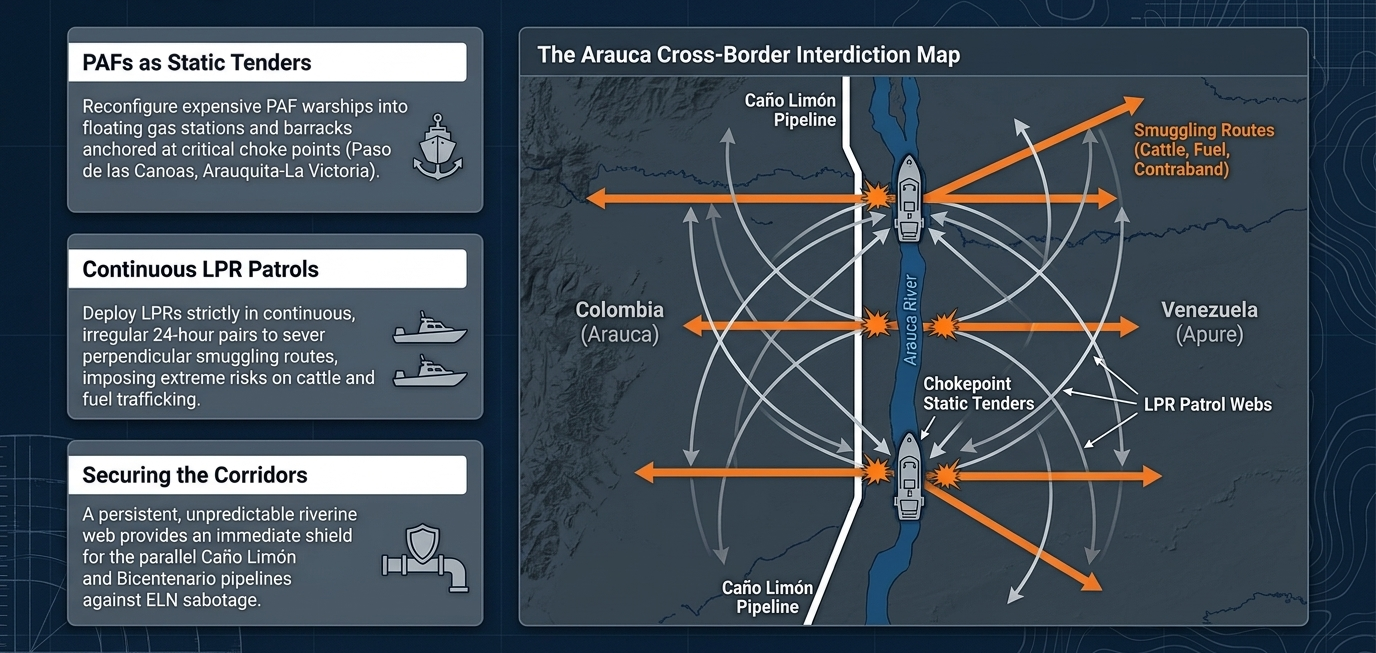
While these are early movements in this proposed operation to command the Arauca River, they must be quickly followed by securing the states' access to its critical funding source in the department. The Cano Limon-Covenas pipeline pumps crude oil from the Cano Limon oil field in Arauca all the way to the Caribbean coast. EcoPetrol oil infrastructure is certain to be targeted by ELN for sabotage to apply leverage for negotiations or tactical advantage (likely in conjunction with a “break out” effort to escape beyond Colombian jurisdiction into Venezuela).
Although the Colombian military maintains a unit dedicated to the pipeline’s protection (The Quiron Task Force) The staggering toll of pipeline attack or theft amounts to $187 million USD per year (1 million barrels) before accounting for “war taxes” paid when infrastructure construction is implemented or for “protection” fees paid to secure material delivery passage and prevent attacks on trucking. Operational force multipliers in the form of drone tech that operates as more than just flying cameras could prove to be indispensable as the cost of continuous, automated arial patrols, in coordination with enhanced riverine units, is a budgetary rounding error by comparison to lost oil revenue suffered. Skyways V2 and Textron Systems Aerosande mk 4.8 drones (VTOL fixed wing hybrid) offer advantages that take into account the operating challenges encountered in Arauca particularly in regard to oil infrastructure defense. Challenges that conjoin seasonally flooded areas that preclude runway takeoff, dense jungle that hides armed group activity, and mountainous/piedmont terrain that exhausts vehicle column access. This category of drone could, with its onboard suite of sensor arrays and 40lb delivery payload, augment current security if operations provoke increased frequency of pipeline attacks. All units, whether they are dedicated to pipeline security or securing the river ways should be augmented with Offensive, Defensive, and ISR (Intelligence, Surveillance, Reconnaissance) drone technology as a force multiplier.
Current doctrine creates a propensity for occasional predictable patrols, in contrast enhanced boat crews equipped with Skydio X10D drones have the ability to scout “over-the-horizon” or around river bends to engage ELN ambush teams or illegal checkpoints. Operation Liberty successfully used small ground units operating in remote areas and with close air support. In this case, many, if not all, of these riverine units would have access to similar capabilities but at a fraction of the cost compared to conventional airframes, making them a critical capability within the scope of this operational proposal.

May-akda
Analysis Team
editor